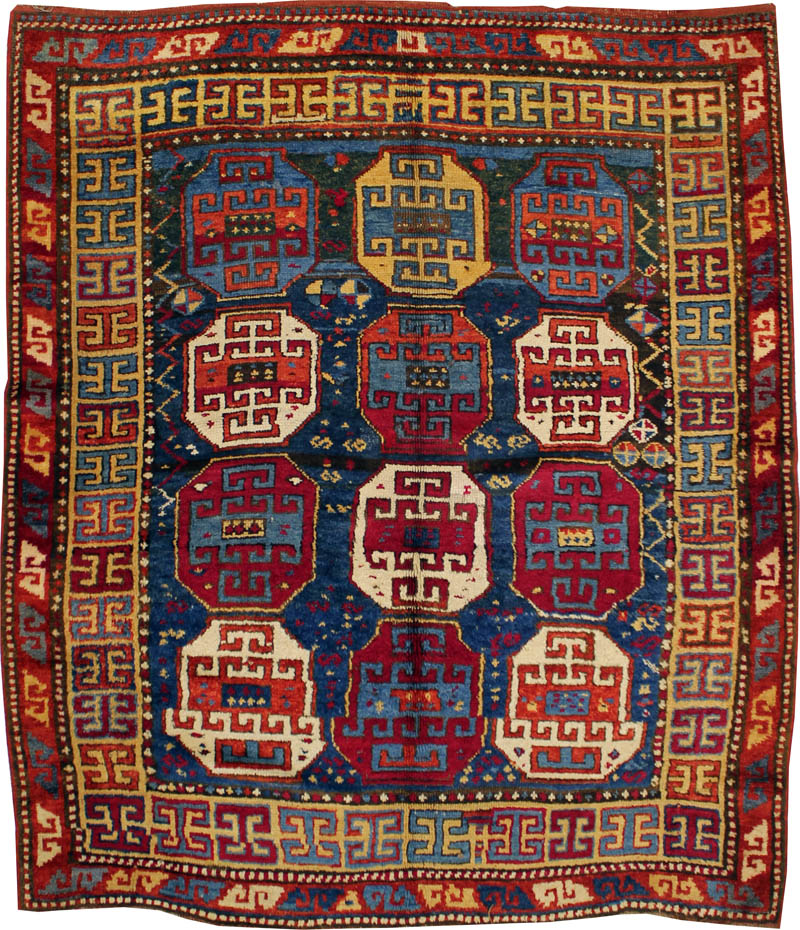
Antique Turkish Rug
Size: 5'3" × 6'9"
Date: 1850s
Material: Wool on Wool
A mid-19th century village rug from eastern Anatolia, most likely from the Karachoph or Yuncu weaving tradition of the Bergama region — areas known for producing rugs with bold, oversized geometric motifs, thick lustrous wool, and an uninhibited approach to colour that makes them among the most visually striking of all Anatolian tribal weavings.
The deep indigo field is covered with a grid of large octagons — eight in total, arranged in four rows of two — each filled with a bold interlocking Greek key or meander device in alternating combinations of ivory, madder, sky blue, gold, and burgundy. No two octagons share exactly the same colour arrangement, which gives the overall composition a dynamic, patchwork energy held together by the consistent indigo ground. The motifs inside the octagons are drawn large and loose, with the slightly rough, spontaneous quality that comes from working at this scale from memory.
The border carries a continuous bold meander in gold and sky blue on a madder ground — wide, strong, and exactly in keeping with the scale of the field motifs. The palette overall — indigo, madder, ivory, gold, and sky blue — is vivid and fully saturated, and at nearly 170 years old the natural dyes show remarkable retention.
An early, bold, and characterful piece from one of Anatolia's most collectible village traditions.