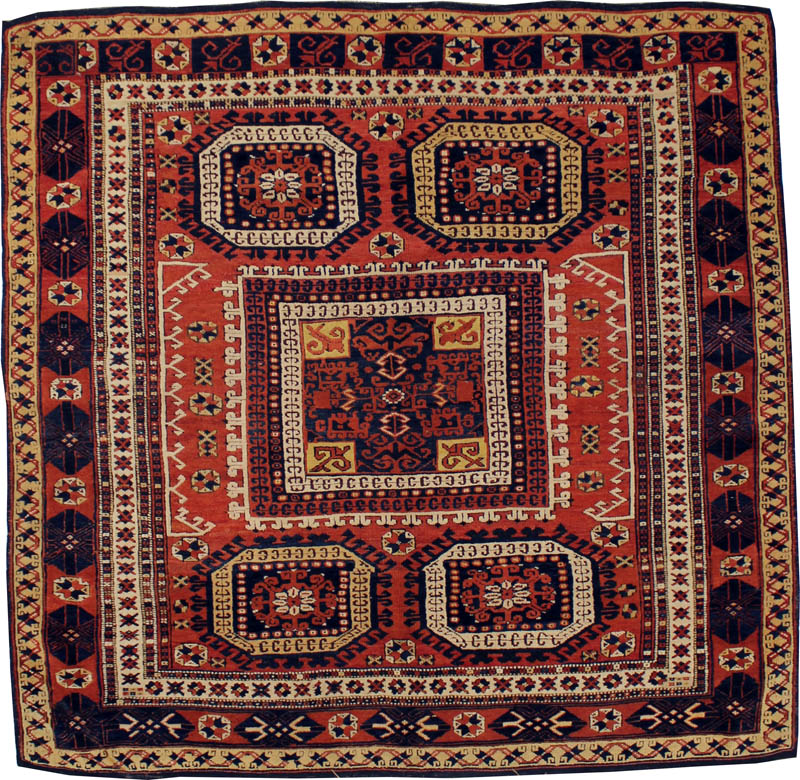
Antique Turkish Bergama Rug
Size: 5'6" × 5'6"
Date: Early 1800s
Material: Wool on Wool
Bergama is one of the oldest weaving centres in Anatolia, a city in western Turkey with a rug tradition stretching back centuries. Bergama rugs are among the most collectible of all Turkish village weavings — typically square or near-square in format, boldly geometric, and woven with the thick, lustrous Anatolian wool that gives them their characteristic tactile weight. A genuine early 19th-century example is a serious antique.
The terracotta-red field is organized around a large central square medallion framed by concentric borders of ivory meander and navy, its interior filled with a dark navy ground carrying bold scrolled forms and geometric devices in gold and madder. Four flanking octagons sit at the corners of the field — two at top, two at bottom — each outlined in ivory or gold and filled with navy and madder geometric patterning. The composition has the characteristic Bergama quality of feeling both architecturally structured and spontaneously drawn at the same time.
The border system stacks several registers — a wide camel band with bold geometric and star forms in navy and red, flanked by narrow reciprocal guard borders — all of which frame the field with considerable presence. The palette of terracotta, deep navy, ivory, and gold has aged over two centuries to a warm, deeply saturated tone that only genuinely old naturally dyed wool develops.
At over 200 years old, this is a piece of real historical significance within the Anatolian weaving tradition.