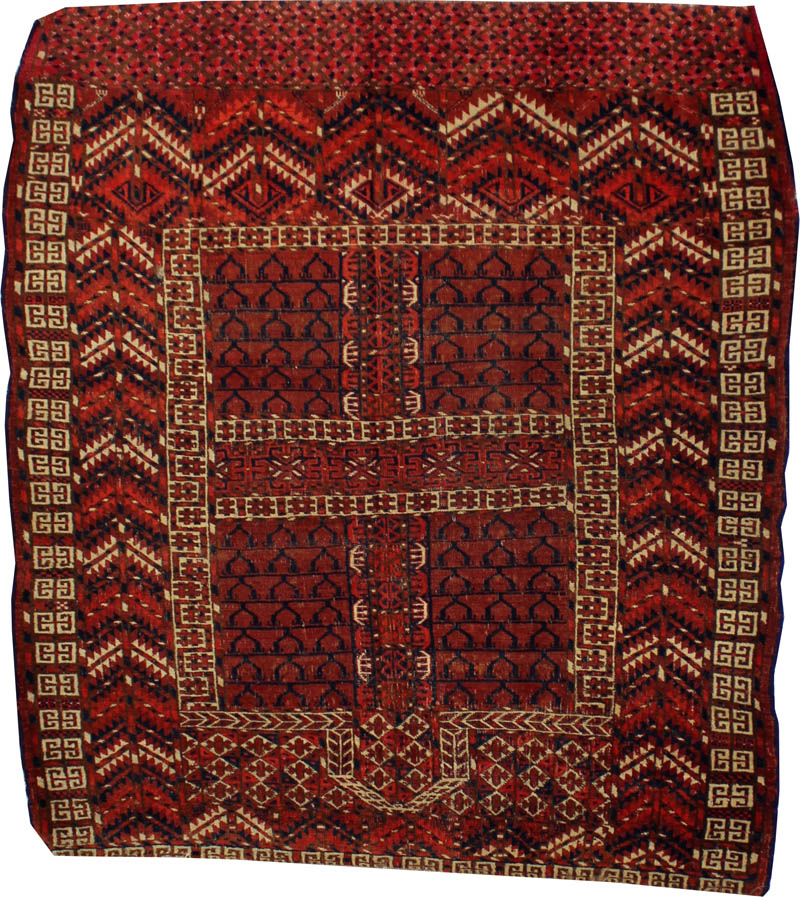
Antique Turkaman Engsi Rug
Size: 4' × 4'6"
Date: 1890s
Material: Wool on Wool
An Engsi is a specific type of Turkaman weaving made to hang across the entrance of a yurt as a door panel — functional, portable, and deeply embedded in the nomadic domestic tradition of the Central Asian steppe. The format is immediately recognizable: a cruciform layout dividing the field into four quadrants, with a distinct horizontal band near the bottom called the elem.
This example follows that format precisely. The deep madder field is quartered by a vertical and horizontal axis, each quadrant filled with rows of small repeating arch forms — miniature mihrab-like shapes stacked in tight horizontal bands across the dark red ground. A central column of geometric devices runs the vertical axis, and a horizontal register of bold geometric forms separates the upper field from the elem panel below, which carries its own repeating diamond and floral motifs. The composition is dense and highly structured, every inch accounted for.
The border system is characteristically Turkaman — a wide chevron and arrow border on both sides in ivory and dark navy, flanked by a Greek key meander on the outer edge. The palette is the near-monochromatic red-on-red typical of Engsi weaving, with ivory and navy providing the only contrast. The pile is low with honest age, consistent with a piece that was used as intended.
A genuine Engsi in this condition is a collectible piece of Central Asian material culture, not just a decorative textile.