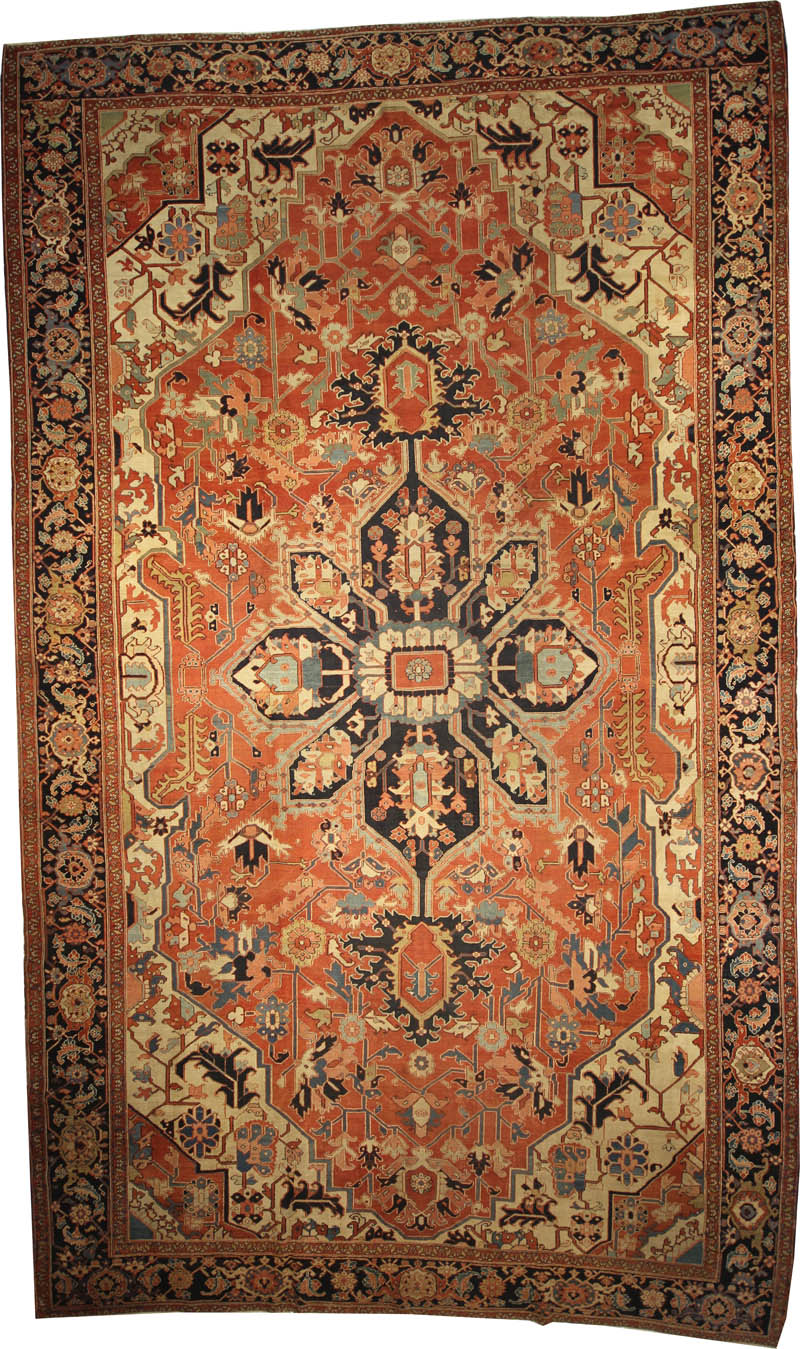
Antique Persian Serapi Rug
Size: 11' × 18'4"
Date: 1860s
Material: Wool on Cotton
Serapi carpets from the villages around Heriz in northwestern Iran represent the pinnacle of what that weaving tradition ever produced. The finest examples date from the second half of the 19th century, are woven to a larger scale than standard Heriz production, and carry a design sophistication and natural dye palette that later commercial output never matched. At 11' × 18'4" and from the 1860s, this is an exceptional carpet by any measure.
The warm terracotta-red field is anchored by a massive central medallion — a large geometric star form in navy, ivory, and slate blue, built from concentric octagonal layers each filled with angular botanical motifs, serrated leaves, and stylized floral devices. The medallion is large enough to command the room on its own, yet the surrounding field is equally resolved: large-scale angular floral forms, bold acanthus leaves, and geometric botanical devices fill the terracotta ground out to the ivory corner spandrels, which carry their own detailed compositions in navy and terracotta.
The wide navy border is densely worked with a continuous floral meander in terracotta, ivory, and sage green, with large palmette accents that punctuate the rhythm at regular intervals. The natural dye palette — terracotta, deep navy, ivory, and slate blue — has developed over 160 years into the warm, slightly abrash-rich surface that defines the best antique Serapi work and that no modern reproduction can replicate.
A carpet of this age, scale, and quality belongs in a serious collection or a significant architectural space.