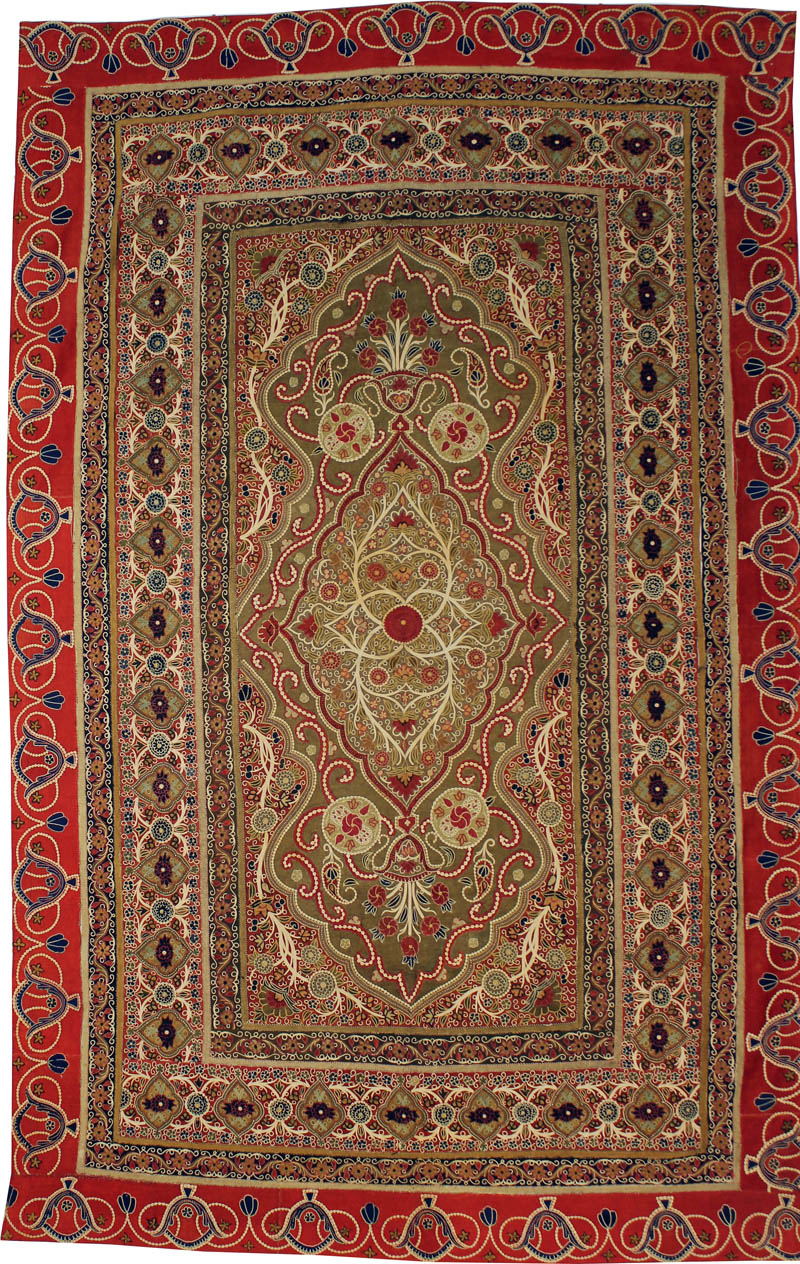
Antique Persian Rasht Douz Embroidery
Size: 4'5" × 7'
Date: 1850s
Material: Wool and Silk
Rasht is a city in the Gilan province of northern Iran, on the Caspian coast, and the needlework tradition that bears its name is one of the most distinctive and labour-intensive textile arts in the Persian world. Rasht Douz pieces are not woven — they are embroidered, built up from thousands of individual chain stitches and appliqué elements worked onto a wool ground fabric. The finest examples, particularly those from the mid-19th century, are serious collector's objects that sit outside the normal rug market entirely.
The olive-green central field is organized around a large lobed medallion filled with an intricate scrolling floral composition — curving ivory vine work, rosette blooms, and botanical forms stitched in madder red, ivory, dusty pink, and sky blue against the muted ground. The embroidery has a sculptural, raised quality distinct from anything a loom can produce, and the individual stitching throughout is exceptionally fine. Multiple stacked border registers surround the field — a narrow geometric inner band, a wider floral scroll band, and the broad outer madder border filled with a repeating series of vase and pomegranate motifs in navy and ivory.
The wide crimson outer border with its boldly repeating vase forms is characteristically Rasht and immediately identifies the origin to anyone familiar with the tradition. At over 170 years old, both the wool ground and the silk embroidery threads retain remarkable colour integrity.
A rare and important piece from one of Persia's most specialized textile traditions.