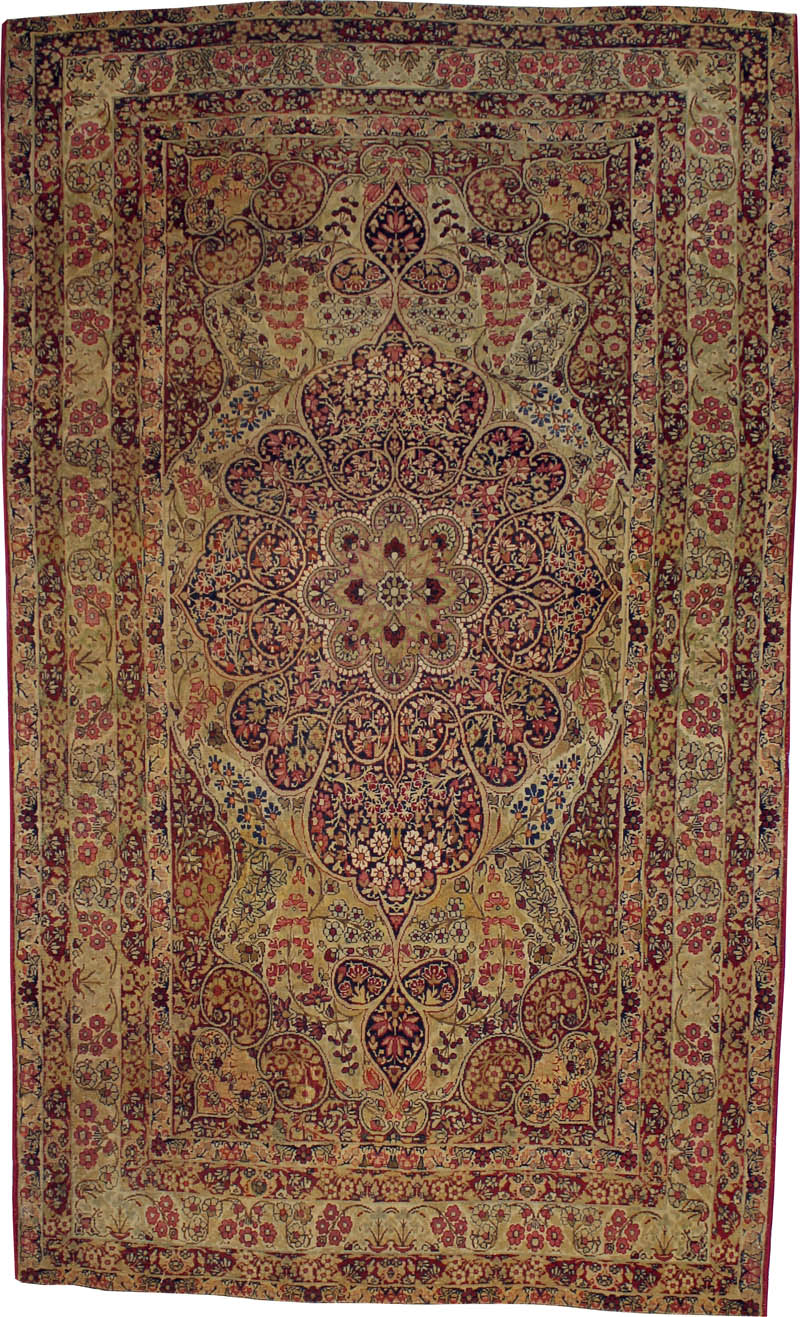
Antique Persian Kerman Ravar Rug
Size: 4'5" × 7'5"
Date: 1850s
Material: Wool on Cotton
Ravar is a town near Kerman in southeast Iran with a distinct weaving identity — producing rugs of exceptional fineness and design ambition that are considered among the best Kerman-area work of the 19th century. Examples from the 1850s place this piece in the earliest and most collectible tier of the tradition, before commercial export production standardized the output of the region.
The aged gold-green field is organized around a large central medallion of lobed cartouche form, its interior densely packed with curvilinear floral scrollwork, blossoming flower heads, and arabesque vine work in navy, dusty rose, ivory, and sage. Large curving ogival forms extend from the medallion outward toward the corners, each lobe filled with its own floral composition, creating a composition that feels like an unfolding garden viewed from directly above. The surrounding field carries additional floral vine work that fills every available space with the same intricate, fine-drawn detail.
The wide border on the gold-green ground carries a continuous small-scale floral repeat in rose and navy, modest in width but fully resolved. After 170 years the palette has mellowed to warm, dusty tones — the navy has softened, the rose has faded to a gentle blush, and the field has taken on the olive-gold patina that only genuine age produces.
A rare and early example of one of Persia's most refined weaving traditions.