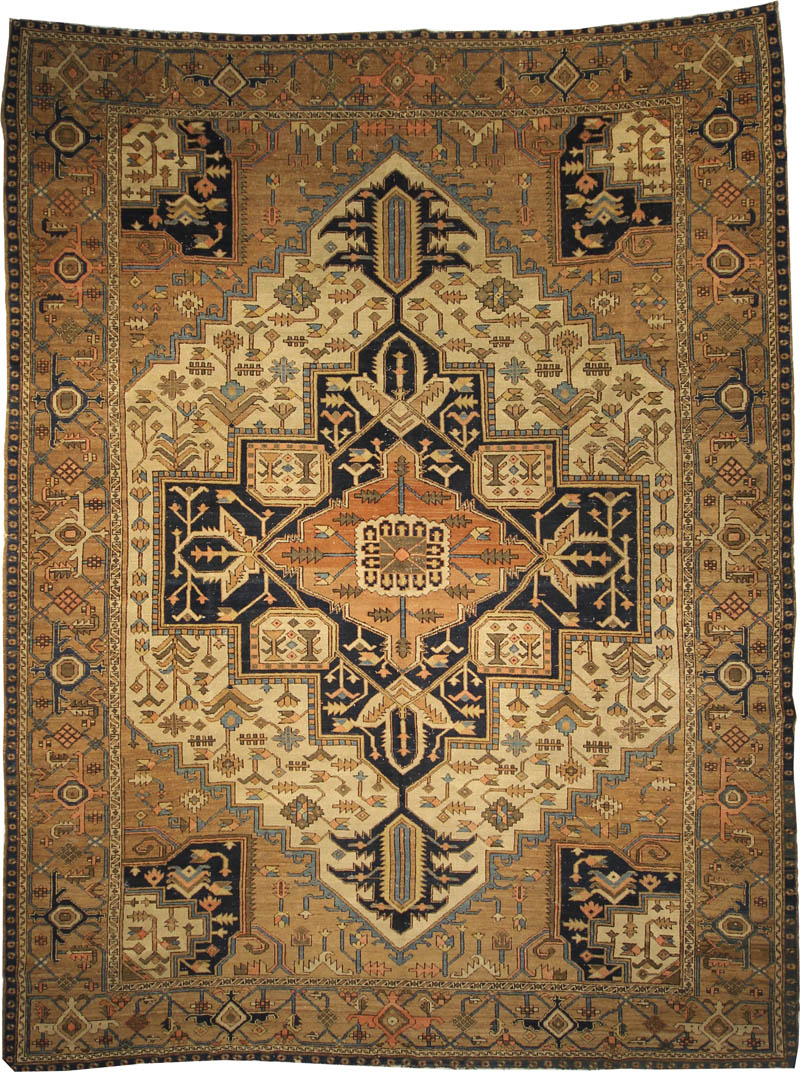
Antique Persian Karajeh Serapi Rug
Size: 10'1" × 13'2"
Date: 1870s
Material: Wool on Cotton
Serapi is the designation given to the finest large-format rugs produced in the villages around Heriz in the late 19th century. The name comes from the town of Serab, and these rugs are distinguished from standard Heriz production by their earlier date, finer knotting, more sophisticated drawing, and the use of naturally dyed wool that develops a distinctive warm, earthy palette over time. A genuine Serapi at this scale and from the 1870s is among the most collectible of all northwest Persian carpets.
The warm camel-brown field is anchored by a large, architecturally complex central medallion built from concentric geometric layers — a terracotta centre core surrounded by navy, then ivory, then navy again, each layer filled with angular botanical forms, stylized tree devices, and geometric motifs drawn with the bold confidence characteristic of the best Serapi work. The four corner spandrels in navy echo the medallion's palette and pull the composition inward from the edges. The field between medallion and corners is populated with angular floral and geometric scatter motifs in ivory, sky blue, and terracotta that give the warm brown ground a textured, lively surface.
The wide camel border carries a continuous geometric repeat in navy and ivory, with a fine reciprocal guard border running the full perimeter. The palette overall — warm camel, deep navy, terracotta, ivory, and sky blue — is the defining characteristic of the Serapi tradition and one that works exceptionally well in both traditional and contemporary interiors.
At over 150 years old and at this size, it is a carpet of genuine importance.