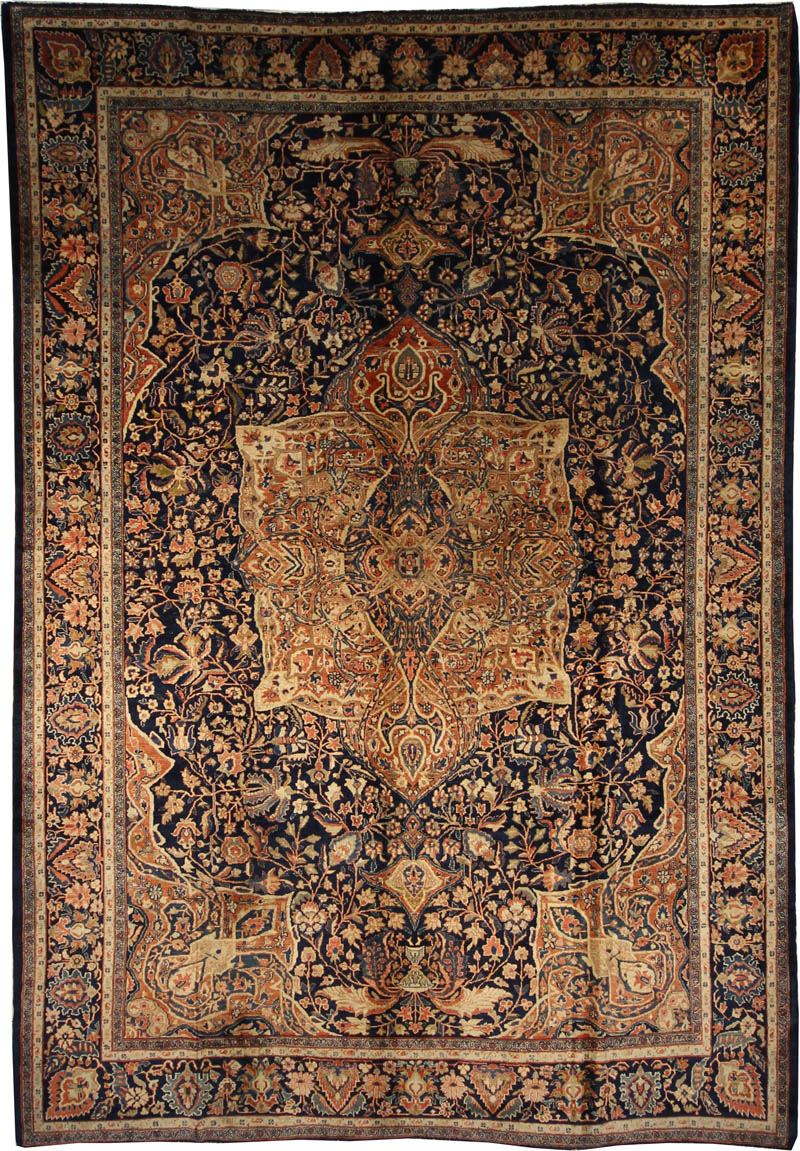
Antique Persian Farahan Rug
Size: 8'6" × 12'4"
Date: 1870s
Material: Wool on Cotton
The Farahan district of west-central Iran produced some of the finest village rugs of the 19th century, and examples from the 1870s represent the tradition at its peak — before commercial pressures standardized output and before synthetic dyes altered the palette. A large-format Farahan of this age in collectible condition is a serious find.
The deep indigo field is anchored by a large ivory and camel central medallion of lobed cartouche form, densely filled with curvilinear floral scrollwork that radiates outward in full bilateral symmetry. The surrounding field is covered with an intricate all-over arrangement of palmettes, flowering vines, serrated leaves, and botanical forms that fill every corner of the deep blue ground without ever feeling mechanical — the drawing has the slightly irregular, hand-worked quality that distinguishes genuine village production from urban workshop output. Look closely and animal figures emerge in the lower field — a detail that adds narrative depth and collector interest to an already accomplished composition.
The border carries a continuous floral meander in madder, camel, and ivory on a navy ground, proportioned correctly for the field size and resolved at the corners without abbreviation. The natural dye palette — deep indigo, madder, camel, ivory, and sage green — has aged over 150 years to a warm, complex depth that no modern reproduction can approach.
At this age, this size, and from this specific tradition, it belongs in a significant collection or a formal room that deserves it.