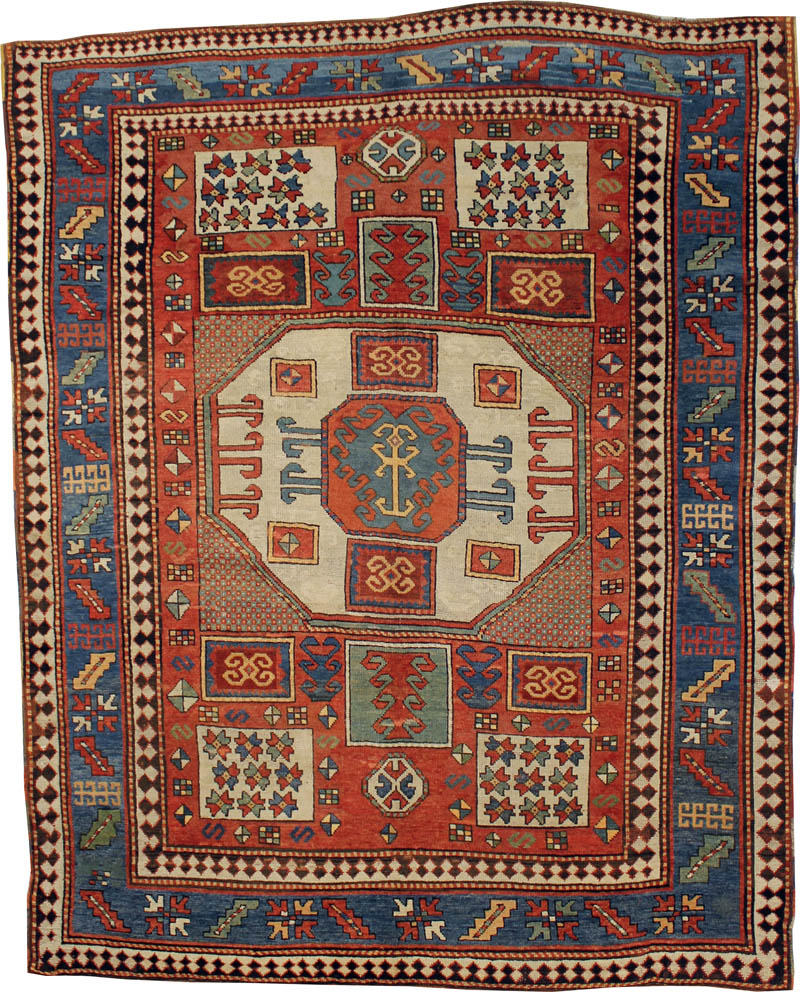
Antique Caucasian Karachov Kazak Rug
Size: 5'6" × 6'11"
Date: Early 1800s
Material: Wool on Wool
The Karachov Kazak is one of the most distinctive and sought-after formats in all of Caucasian weaving. Made in the villages of the southwestern Caucasus, these rugs are identifiable by their characteristic layout — a large central octagonal medallion on an open field, surrounded by a series of rectangular panels arranged like a frame within the field, each containing its own independent design. Examples from the early 19th century are rare and represent the tradition at its most original.
The madder-red field is organized around a large ivory-ground octagon at centre, containing a bold stepped medallion in terracotta and slate blue with a distinctive hooked device at its heart. Flanking the central octagon on all four sides are rectangular panels — two ivory panels filled with star rosette scatter patterns at top and bottom, and further panels carrying bold scrolled forms and geometric emblems in navy, gold, and sage green. The whole arrangement sits within the red field like a composition of separate pictures, each panel self-contained yet part of a coherent whole.
The wide slate-blue border carries a repeating sequence of bold geometric devices, arrows, and tribal emblems in red, ivory, and gold — energetic and well-scaled against the field. The palette — madder, slate blue, ivory, sage, and gold — has aged over two centuries to a warm, deeply settled tone that only genuinely old naturally dyed wool achieves.
At over 200 years old, this is a significant and collectible piece from one of the Caucasian tradition's most celebrated formats.